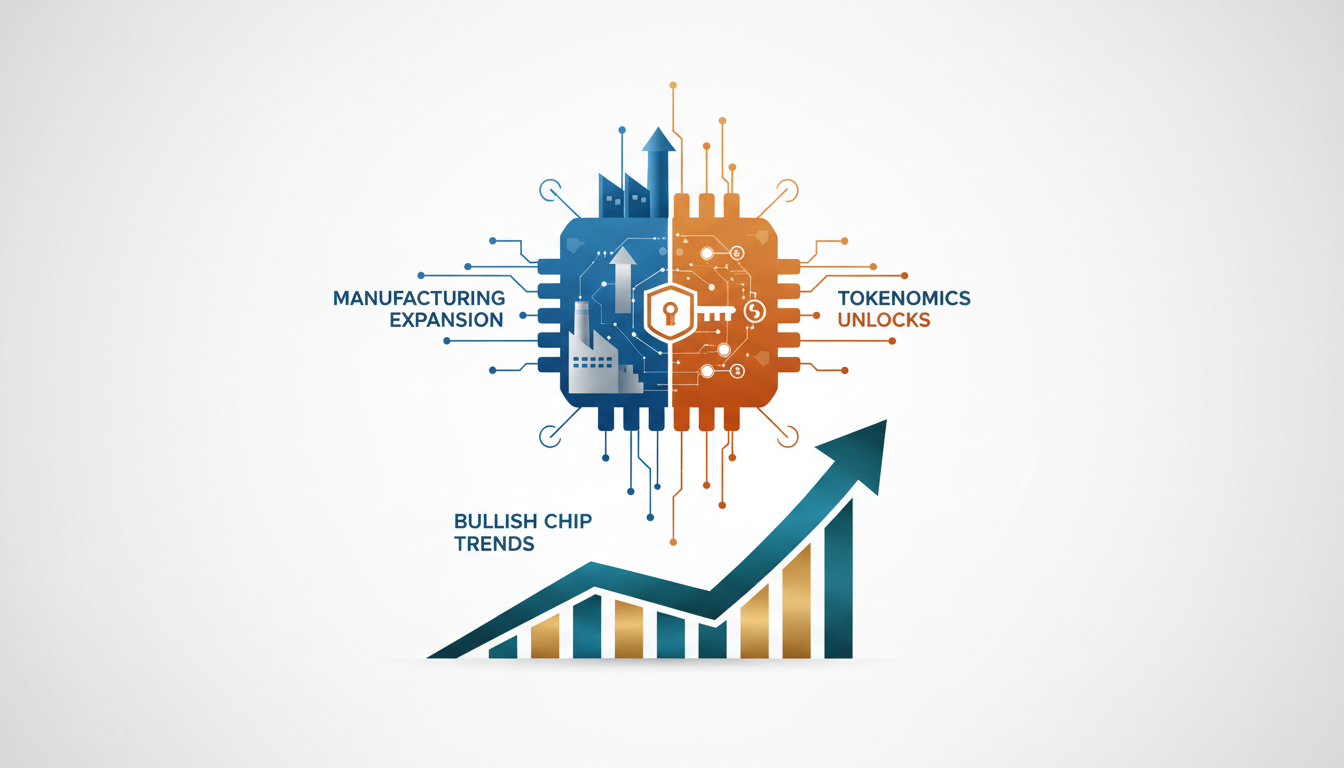
AMD Manufacturing Expansion Meets Tokenomics Unlocks Amid Bullish Chip Trends
AMD's May 2026 commitment of more than $10 billion to Taiwan underscores sustained semiconductor expansion 2026 amid rising AI demand. Q1 2026 earnings
Summary
- AMD's May 2026 commitment of more than $10 billion to Taiwan underscores sustained semiconductor expansion 2026 amid rising AI demand.
- Q1 2026 earnings strength at peers like Qualcomm highlights robust AI chip earnings across handsets, automotive, and IoT sectors.
- Token unlock calendars for assets such as ONDO introduce potential short-term volatility layers for investors monitoring chip sector sentiment.
In late May 2026 Lisa Su stepped off a plane in Taiwan and straight into a room full of partners already buzzing with plans. The AMD CEO had come to lock in an investment that would reach across the island's chip ecosystem, and everyone knew the stakes were high. Announcements started rolling out that week while the real attention stayed on factories, packaging lines, and those long supply chains turning silicon into AI systems.
Background
Advanced Micro Devices started as a scrappy challenger to the big chipmakers decades back. It built its spot in CPUs and GPUs before shifting hard into data-center accelerators once AI workloads took off. Key moves included the EPYC server processors and the Instinct GPU line, each one timed to ride the next wave of compute demand.
The company's strategy always leaned on partnerships instead of owning every fabrication step. That approach turned urgent once AI training clusters demanded specialized packaging and advanced nodes. By 2026 the push for tighter ties with Taiwan's foundry and assembly network had grown obvious.
"More than $10 billion in investments across the Taiwan ecosystem to expand strategic partnerships and scale advanced packaging capabilities for ..."
, Attribution (www.amd.com)
Current
On May 20, 2026 AMD laid out the full scale of its Taiwan plans. The money targets strategic partnerships plus advanced packaging capacity at several suppliers. CEO Lisa Su's visit two days later drove home that production ramp schedules were already moving forward.
Q1 2026 results from peers showed the same steady demand. Qualcomm posted record numbers powered by handsets, automotive, and IoT, all areas that draw on the same process technologies AMD is expanding. These AI chip earnings landed right as sector rallies picked up steam.
Tokenomics events now sit right next to those classic metrics. Scheduled unlocks for tokens like ONDO could spark fresh price swings depending on market conditions. Investors tracking semiconductor expansion 2026 have to juggle factory timelines and crypto calendars when they read the room. Which, if you've been watching this space, shouldn't be surprising.
"AMD said on Thursday it would invest more than $10 billion in Taiwan's AI sector to deepen strategic partnerships and expand its capacity to ..."
, Attribution (www.reuters.com)
Impact
The Taiwan commitment shows AI infrastructure buildout will stretch across multiple years instead of riding a short cycle. Packaging capacity remains the real choke point for high-performance accelerators, so expanding those lines directly feeds the next round of training and inference clusters. And honestly, that's a big deal.
Earnings strength at firms like Qualcomm backs the idea that demand spreads wide rather than sitting in one narrow lane. This spread gives semiconductor companies room to ride out any brief dip in a single segment while other areas keep growing.
"The company said investments would be made “across the Taiwan ecosystem to expand strategic partnerships and scale advanced packaging ..."
, Attribution (www.taipeitimes.com)
Investors weighing AMD Taiwan investment announcements now face one extra variable. Token unlock schedules can shift risk appetite across correlated assets even when the core chip fundamentals hold steady. Monitoring both calendars has turned into basic diligence.
Back in that Taiwan conference room the talk had already moved past press releases to actual timelines for equipment installation. Those same rooms will see follow-up sessions in the months ahead, where progress on packaging lines gets measured against the AI demand signals that sparked the original $10 billion pledge. The tokenomics layer simply adds one more rhythm that executives and investors have to track together.