Arbitrum DAO's $71M ETH Vote: Navigating Legal and Scaling Challenges in 2026
Arbitrum DAO voted to release 30,765.67 ETH (approximately $70-71 million) to compensate victims of the Kelp DAO rsETH exploit, despite facing legal
Summary
- Arbitrum DAO voted to release 30,765.67 ETH (approximately $70-71 million) to compensate victims of the Kelp DAO rsETH exploit, despite facing legal hurdles.
- The decision coincides with a U.S. court restraining notice delaying the transfer, highlighting tensions between decentralized governance and regulatory oversight.
- Arbitrum's token (ARB) surged 3.84% following the vote, signaling market confidence amid ongoing uncertainty.
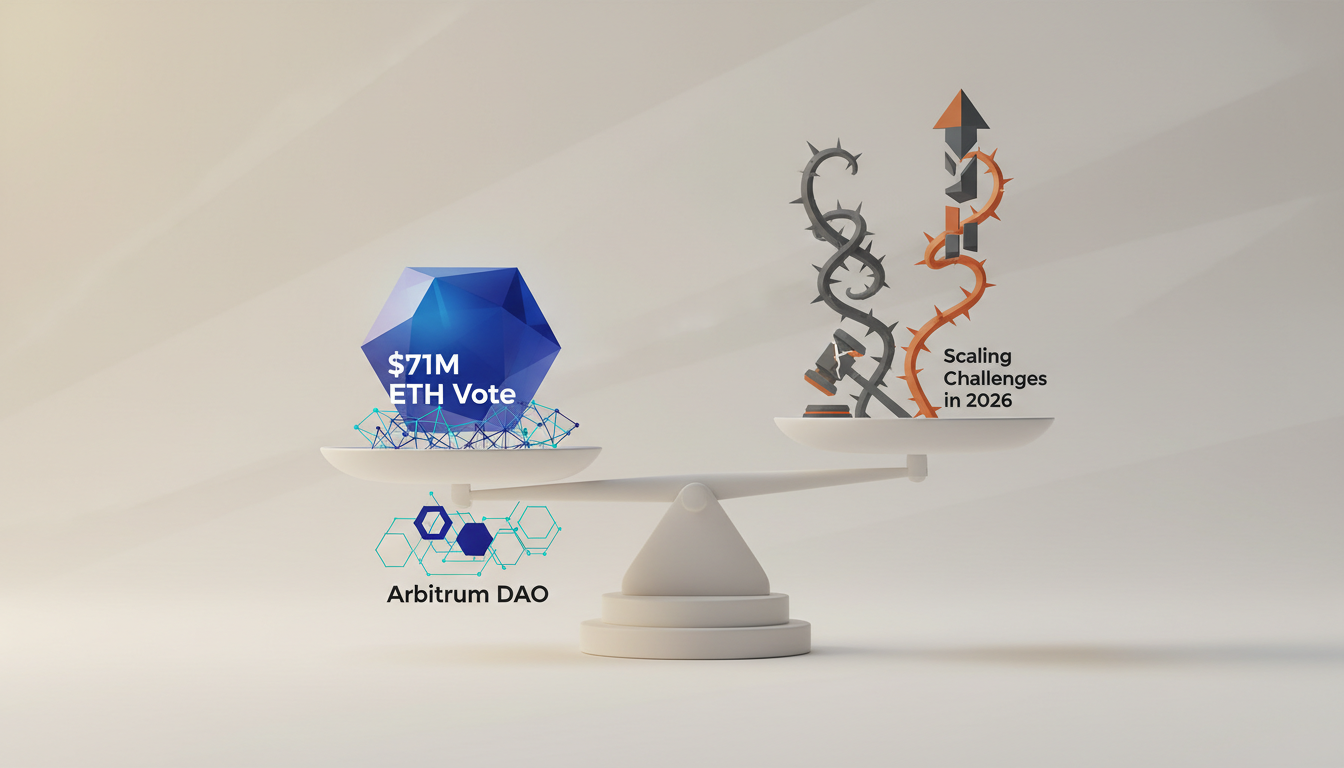
In a landmark decision for decentralized finance (DeFi), Arbitrum DAO voted in May 2026 to release 30,765.67 ETH, valued at roughly $70-71 million, to compensate victims of the Kelp DAO rsETH exploit.
This move aims to mitigate damage in the Ethereum Layer 2 ecosystem, but it faces legal challenges like a U.S. seizure fight and a court restraining notice that blocks the transfer.
Reports from Indexbox.io and CoinDesk highlight the vote's governance complexities in blockchain.
Why does this matter now?
The decision addresses a major exploit and tests how decentralized autonomous organizations (DAOs) fit under traditional legal rules.
With Arbitrum's token (ARB) rising 3.84% after the vote as noted by CoinMarketCap, the market looks optimistic.
Yet the ongoing court battle could shape future precedents for DeFi protocols and regulators.
"Arbitrum DAO voted to release 30,765.67 ETH (approx. $70M) to compensate Kelp DAO rsETH exploit victims, but faces a legal restraining notice delaying the process."
, Indexbox.io (Source)
Context: The Growing Stakes of Layer 2 Governance
Ethereum Layer 2 solutions like Arbitrum help scale the blockchain's capacity by handling transactions off the main chain and cutting costs.
As the Enterprise Ethereum Alliance explains, technologies such as rollups and sidechains let businesses use blockchain at scale, and Layer 2 networks hold over $34 billion in total value locked (TVL) in 2026.
Arbitrum and rivals like Optimism and Base manage a big slice of those transactions.
The Kelp DAO rsETH exploit revealed risks in DeFi protocols on Layer 2s and sparked a governance crisis for Arbitrum DAO.
This event, combined with U.S. court scrutiny, shows a key conflict.
How can decentralized systems maintain user trust and handle recoveries while following regulatory rules?
Details: Breaking Down the Vote and Legal Roadblocks
The Arbitrum DAO's decision to unfreeze 30,765.67 ETH responded directly to the Kelp DAO exploit and sought to support affected users through the DeFi United initiative.
At about $70-71 million, this release shows a strong commitment to ecosystem recovery, as Indexbox.io and CoinMarketCap report.
The vote gained overwhelming community support for victim compensation.
A U.S. court restraining notice has delayed the transfer as part of a larger seizure fight over the assets, per CoinDesk.
This raises issues about jurisdiction over decentralized protocols and DAOs' autonomy.
Some details of the legal proceedings are still private, and reporting continues to develop.
Reaction: Market Confidence Amid Uncertainty
Arbitrum's token, ARB, jumped 3.84% after the vote, indicating investor optimism about the protocol's risk management, according to CoinMarketCap.
Community sentiment seems to match this positivity based on initial discussions.
The approach to compensating victims could strengthen Arbitrum's leadership in Ethereum scaling despite legal threats.
Social Highlight · @mpost_io · Date Unknown
🗳️The Arbitrum DAO has voted to release the frozen 30,765.6 $ETH, approximately $70M, to the DeFi United initiative, formed to help mitigate... (link)
The U.S. court case's outcome will matter a lot for Arbitrum DAO and DeFi.
If they lift the restraining notice, the ETH transfer might go ahead and set a standard for DAOs in legal situations.
A long legal fight could slow compensation and spark arguments about regulatory control in decentralized setups.
Stakeholders should monitor Ethereum Layer 2 updates through sites like L2BEAT to assess Arbitrum's position.
The next few weeks may reveal if decentralized governance can adjust to legal demands while keeping its spirit.