Cross-Chain Bridges Enable Blockchain Interoperability Across Ecosystems Like NEAR and Ethereum but Remain Vulnerable to Structural Security Risks That Limit Institutional Adoption in 2026
Cross-chain bridges facilitate asset transfers across ecosystems such as Ethereum, Solana, and NEAR. Protocols including CCIP target universal connections
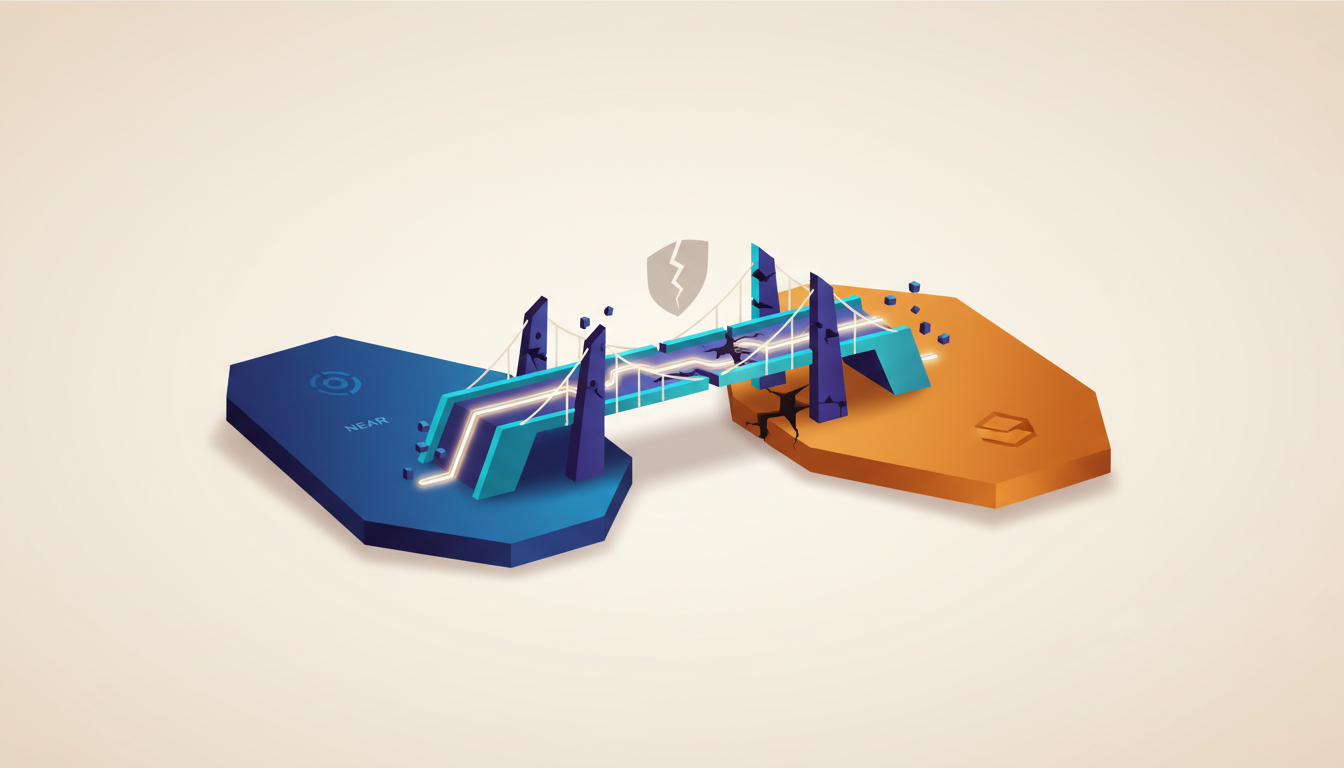
Summary
- Cross-chain bridges facilitate asset transfers across ecosystems such as Ethereum, Solana, and NEAR.
- Protocols including CCIP target universal connections between hundreds of blockchain networks.
- Security vulnerabilities in bridges like Wormhole continue to restrict institutional trust and adoption.
In July 2026, multiple layer-1 networks including NEAR and Solana are expanding their reliance on cross-chain bridges to move assets and data. This activity occurs against a backdrop of repeated exploits and latency problems in established protocols. The pattern shows both the growing necessity of these tools and the structural limits they still carry.
Cross-chain bridges enable blockchain interoperability across ecosystems like NEAR and Ethereum but remain vulnerable to structural security risks that limit institutional adoption in 2026. The technology solves a core fragmentation problem. Yet the same mechanisms that make transfers possible also create single points of failure that large institutions continue to avoid.
How Leading Protocols Support Transfers
Cross-chain bridges function by locking assets on one chain and issuing equivalent representations on another. This mechanism allows movement from Ethereum to Solana or similar pairings without requiring users to exit to centralized exchanges. Quicknode documentation notes that such bridges make transfers possible across ecosystems including Base and Arbitrum.
Chainlink's Cross-Chain Interoperability Protocol (CCIP) extends this model further. It seeks to create a universal connection layer that links hundreds of public and private networks. The design aims to unlock isolated tokens and data so they can interact across previously siloed environments. Taurus analysis of the protocol highlights its role in standardizing message passing and token transfers at scale.
In practice, NEAR and Ethereum teams have leaned on these systems during July 2026 to support expanded bridge volume. The ETH-NEAR Rainbow Bridge, alongside Wormhole routes, handles routine flows that would otherwise require manual wrapped-asset management. These implementations demonstrate measurable progress in daily operational reach. And honestly, that's a big deal when you consider how fragmented things still feel on the ground.
- Ethereum-to-Solana transfers via established bridges
- NEAR integration with multiple destination chains
- CCIP testing across both public and permissioned environments
Evidence of Expanding Usage Patterns
July 2026 data from active layer-1 networks shows increased bridge calls tied to native ecosystem growth. Solana and NEAR developers are routing more liquidity through these pathways to support decentralized applications that span chains. The result is higher total value locked in bridge contracts and more frequent message executions between networks.
This expansion aligns with the broader goal of blockchain interoperability. Research on interoperability protocols published on ResearchGate notes that 2024 advances already improved trustless transaction execution and dApp integration, a trajectory that continued into 2026. The practical effect is that users and applications can treat separate chains as a single, addressable surface rather than isolated silos.
Chainlight's review of interchain protocols underscores that operational coverage has widened even as individual implementations retain distinct security assumptions. The cumulative effect is visible in the July 2026 activity levels across NEAR and Solana deployments.
"CCIP aims to establish a universal connection between hundreds of blockchain networks, both private and public, unlocking isolated tokens and data."
, Chainlink (Source)
Security Risks Remain the Central Constraint
Wormhole security incidents illustrate the persistent exposure. An earlier exploit compromised ETH representations on Solana because of code-level weaknesses combined with permissive validation practices on the destination chain. Reddit discussion of the event notes that the flaw originated in the bridge code yet was amplified by Solana's handling of malformed messages.
These structural risks have not disappeared. Bridge contracts must custody or validate assets across trust boundaries, creating attractive targets. Even when patches are applied, the fundamental design requires some form of validator or guardian set whose compromise can affect all bridged value. Institutions evaluating these systems therefore face ongoing questions about custody, audit frequency, and recovery procedures.
The implication is straightforward: technical reach has advanced faster than verifiable security guarantees. This mismatch directly caps the size of institutional flows that route through cross-chain bridges. Which, if you've been watching this space, shouldn't be surprising.
Key Insight: Security Design Trade-offs
Protocols gain connectivity by accepting validator or guardian models that concentrate risk, a pattern observed across multiple bridge architectures.
Source: Chainlight
Outlook and Open Questions
The weight of current evidence points to continued functional growth in cross-chain bridges tempered by the same security surface that has produced past losses. CCIP and similar standards may narrow some attack vectors through standardized verification, yet no protocol has eliminated the need for trusted intermediaries at the bridge layer. Institutions therefore remain selective, favoring limited or permissioned use cases while retail and smaller protocols drive most volume.
This means that blockchain interoperability will likely keep advancing along current lines through the remainder of 2026. The open question worth watching is whether a new verification or insurance primitive can materially shift institutional risk calculations, or whether the sector will settle into a two-tier market of high-volume retail bridges and narrowly scoped enterprise connections.