Five AI Crypto Projects to Watch in September 2026 Amid Chip Restrictions
US export restrictions on advanced AI chips are closing loopholes that previously allowed Chinese access to NVIDIA hardware, with direct effects on supply
Summary
- US export restrictions on advanced AI chips are closing loopholes that previously allowed Chinese access to NVIDIA hardware, with direct effects on supply dynamics this quarter.
- Broadcom guided revenue around $34.8 billion for the current period and forecasts a surge in AI chip sales over the next two years as it challenges NVIDIA dominance.
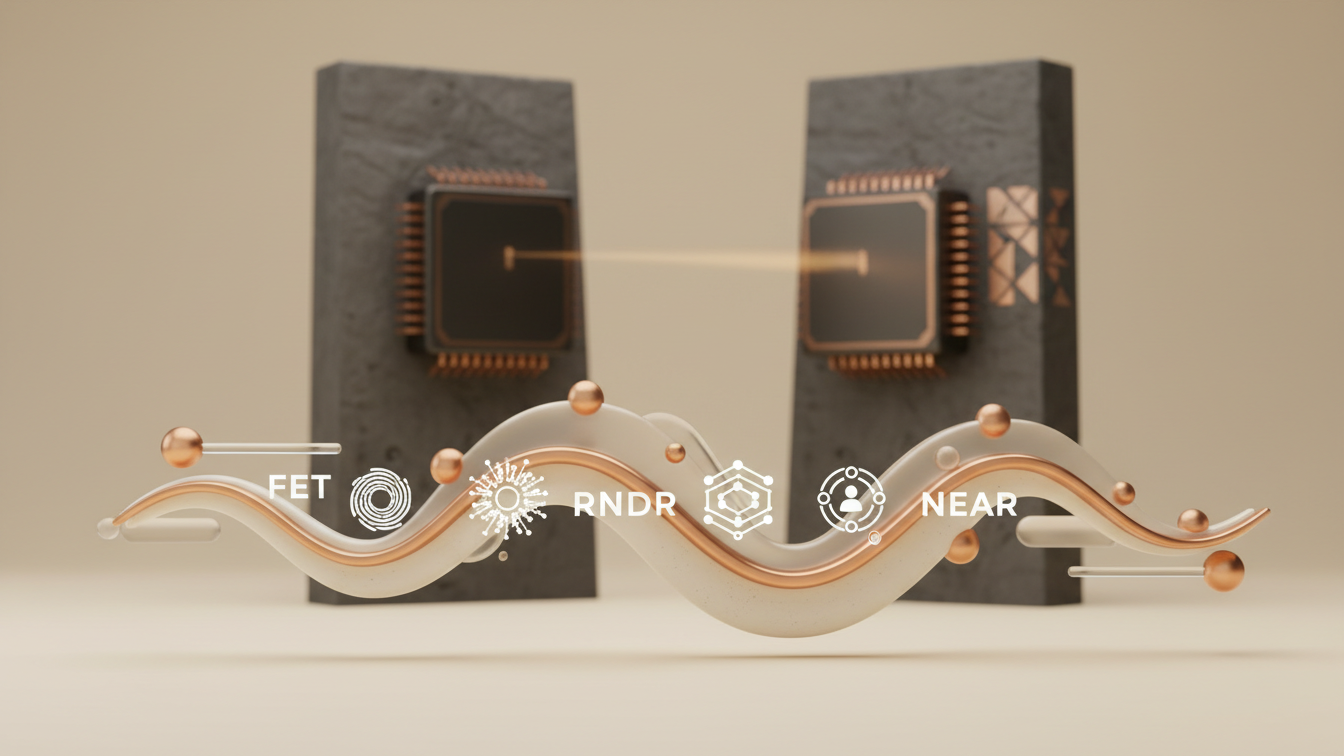
- Projects such as FET, RNDR, TAO, and NEAR gain visibility because they rely on decentralized compute rather than restricted centralized chips.
Broadcom guided the current quarter to land around $34.8 billion in revenue. That single figure captures the scale of demand for AI accelerators even as Washington tightens controls on the most advanced models. The number arrives at the same moment fresh curbs target H200 and Blackwell chips destined for China.
These restrictions are reshaping supply dynamics for NVIDIA while spotlighting ai crypto tokens that leverage decentralized compute and user-owned models. The thesis rests on two concurrent developments: policy pressure on centralized hardware and growing attention to alternatives that bypass those constraints. September 2026 therefore marks a period when token momentum around projects such as FET, RNDR, TAO, and NEAR aligns with hardware policy shifts.
Chip Policy Headwinds and Market Impact
The United States has moved to close a loophole that may have allowed Chinese companies to access advanced NVIDIA AI chips through overseas subsidiaries. This action follows earlier export rules aimed at H200 and Blackwell architectures. The policy directly affects NVIDIA's ability to serve a major market segment without altering the underlying demand for high-performance compute.
Broadcom, by contrast, delivered guidance that signals continued expansion. Its forecast of a surge in artificial intelligence chip sales over the next two years renews optimism that the company can challenge NVIDIA's position. Revenue guidance near $34.8 billion reflects orders already in the pipeline and expectations for sustained growth in custom accelerators. And honestly, that's a big deal given how quickly policy can shift the board.
This divergence illustrates how restrictions on one supplier can accelerate interest in both competing chip designers and non-chip alternatives. The implication is that centralized hardware supply faces friction. Companies and developers seeking AI capacity now evaluate options that do not depend on the restricted export channels. That evaluation naturally extends to decentralized networks capable of coordinating compute across borders.
Top AI Crypto Tokens Overview
Source material from bitcoinfoundation.org highlights four projects that stand out in current discussions of ai crypto tokens. FET focuses on agent-based infrastructure, RNDR on rendering and compute marketplaces, TAO on subnet economies, and NEAR on broader blockchain tooling with an emphasis on user-owned AI. Each approach reduces reliance on hardware that is subject to export controls.
TAO powers Bittensor's subnet economy, allowing participants to contribute models and data in a permissionless setting. NEAR Protocol AI emphasizes user-owned models that can run across distributed nodes. These designs align with the current environment because they do not require the latest centralized chips to deliver functional AI services. FET and RNDR similarly route workloads through token-incentivized networks rather than single-vendor data centers.
Market attention in September 2026 therefore tracks both token-specific upgrades and the broader hardware backdrop. The combination creates a window where decentralized compute narratives receive fresh capital and developer focus.
- FET: agent infrastructure for autonomous tasks
- RNDR: distributed rendering and GPU coordination
- TAO: Bittensor subnet incentives for model contribution
- NEAR: user-controlled AI tooling on a general-purpose chain
Competitive Landscape with Broadcom and Qualcomm
Broadcom's earnings release and forward guidance place it alongside NVIDIA as a primary beneficiary of AI spending. Qualcomm has also signaled strength in automotive and edge AI platforms. Yet both companies operate within the same regulatory perimeter that limits sales of the most advanced silicon to certain jurisdictions. The result is parallel pressure on automotive timelines that depend on NVIDIA DRIVE-class hardware.
Export curbs may indirectly slow automotive AI adoption timelines for NVIDIA. This risk sits alongside Broadcom's more optimistic chip-sales outlook. The contrast shows that policy effects are not uniform across the semiconductor stack. Some segments face immediate volume risk while others see sustained or even accelerated demand.
Counterpoint
AGIX requires special treatment amid shifting token landscapes, according to the same bitcoinfoundation.org summary that covers the other projects. Its positioning differs enough from FET, RNDR, TAO, and NEAR that direct comparisons need adjustment. In addition, the curbs on advanced chips could blunt near-term automotive use cases even if enterprise and data-center demand remains robust elsewhere.
This means the headline growth story for decentralized alternatives is not guaranteed. Regulatory tightening can create both opportunity and friction depending on the vertical and the token's technical focus.
Synthesis
The weight of evidence points to continued divergence between centralized hardware paths and decentralized compute networks. Broadcom's $34.8 billion guidance and the closure of NVIDIA export loopholes together frame a market in which ai crypto tokens that avoid restricted chips receive structural tailwinds. At the same time, the AGIX caveat and automotive timeline risks remind observers that adoption curves will vary.
The practical outcome is selective attention: projects with clear subnet or user-owned model mechanics stand to capture narrative and capital flows more readily than those tied to legacy centralized dependencies. Which, if you've been watching this space, shouldn't be surprising.
What remains to be seen is whether the current quarter's token momentum around bittensor tao and near protocol ai sustains once the next round of hardware policy adjustments or competitive product launches takes effect.