Gensler Backs States Over CFTC in Prediction Market Battle
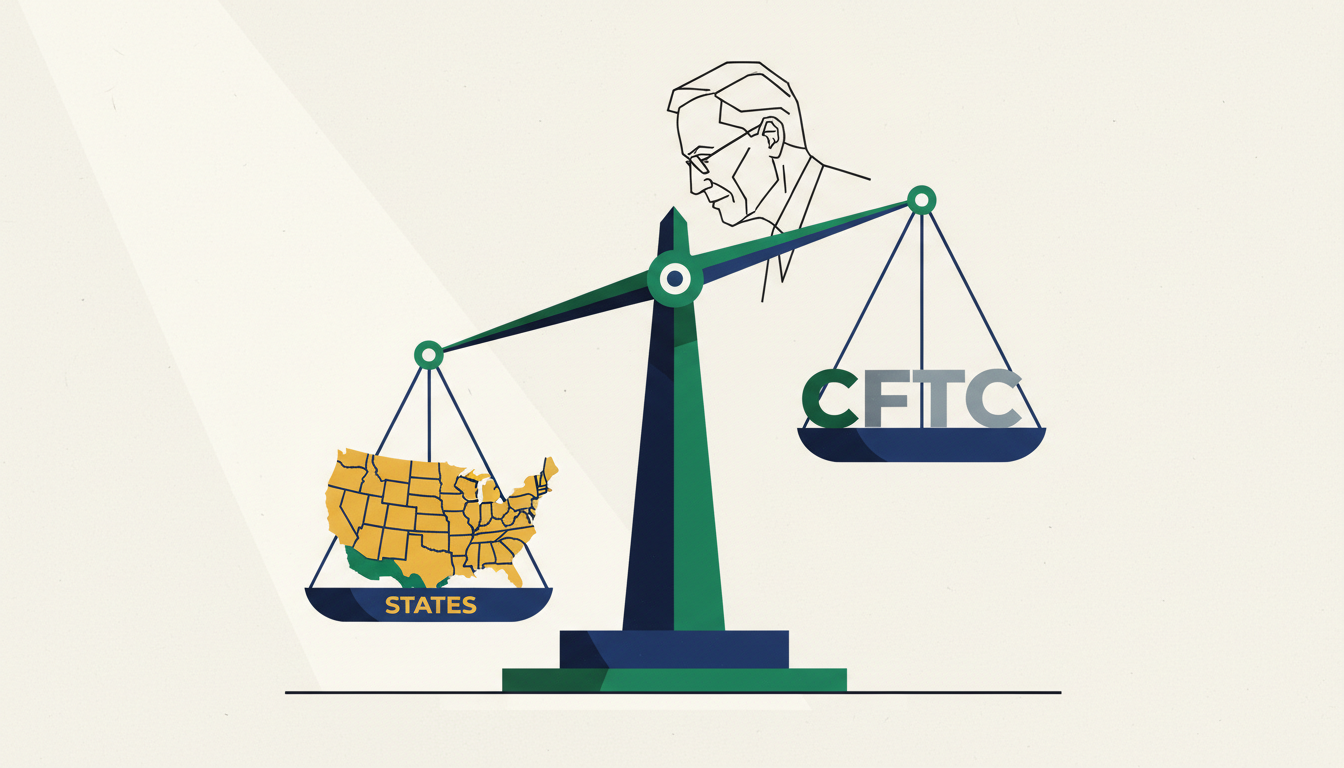
Gary Gensler argues that Congress never gave the CFTC sole power over sports-related prediction markets, preserving state authority. The CFTC's May 2026
Summary
- Gary Gensler argues that Congress never gave the CFTC sole power over sports-related prediction markets, preserving state authority.
- The CFTC's May 2026 amicus brief and June rulemaking attempt to expand federal oversight but face direct pushback on preemption grounds.
- Crypto-linked platforms now face ongoing uncertainty as litigation in the Sixth Circuit tests the boundary between federal swaps rules and state sports betting laws.
Gary Gensler has it right. Congress never handed the CFTC exclusive jurisdiction over sports-related prediction markets, and states retain the authority they have long exercised. The former chairman's intervention in the Sixth Circuit litigation makes clear that federal preemption claims rest on shaky statutory ground rather than any explicit legislative choice.
This position matters because prediction markets are expanding fast, and crypto platforms sit at the center of the conflict. If the CFTC could sweep these contracts under its swap or derivatives umbrella without congressional direction, state sports betting regimes would lose practical meaning.
Gensler's reading of the law correctly blocks that outcome.
Congressional intent leaves no room for blanket preemption
The core of Gensler's argument is straightforward: lawmakers never intended to place sports betting under exclusive federal control when they shaped the CFTC's authority. As he stated in court filings and interviews, Congress "categorically" did not intend to put sports betting under exclusive federal oversight. That reading aligns with the historical record, where sports wagering remained largely a state matter even after major derivatives reforms.
The timing of his comments is telling. In May 2026 the CFTC filed its amicus brief in the Sixth Circuit claiming exclusive jurisdiction over prediction markets. Gensler responded publicly the following month, underscoring that no statutory text or legislative history supports the agency's broad preemption theory.
His view rests on what Congress actually did and did not say, not on later agency interpretations. One practical result is that states can continue regulating sports betting without automatic federal displacement. This preserves the dual system that has operated for years and avoids forcing every event contract into a derivatives framework designed for different risks.
"Congress categorically did not intend to put sports betting under exclusive federal oversight."
, Gary Gensler (Yahoo Finance)
Crypto platforms face real stakes in the outcome
Prediction markets tied to crypto assets now operate in a gray zone between state gambling rules and federal derivatives oversight. If the CFTC's preemption claim succeeds, platforms would face uniform federal standards that could override varying state approaches. Gensler's stance pushes back against that consolidation and keeps regulatory experimentation alive at the state level.
The June 2026 proposed amendments on event contracts only heighten the tension. Those rules would expand the CFTC's public-interest review, yet they cannot create jurisdiction that Congress withheld.
Crypto-linked markets that offer sports or election contracts therefore have a direct interest in the Sixth Circuit outcome, because the decision will shape whether they must register as swap execution facilities or can continue under state licensing. And honestly, that distinction affects innovation speed. State-level oversight has allowed quicker iteration in some jurisdictions, while a single federal regime risks slower approvals and higher compliance costs for smaller platforms.
The CFTC's jurisdiction claim is the strongest counterargument
The agency maintains that prediction-market sports contracts qualify as swaps or derivatives and therefore fall under its exclusive authority. Its May 2026 amicus brief in the Sixth Circuit and the simultaneous complaints filed earlier in Illinois rest on this characterization. If courts accept that framing, state laws could be preempted even without explicit congressional language.
Yet the argument falters on the absence of clear statutory direction. The CFTC's position treats the classification of these contracts as self-evident, but Gensler correctly notes that Congress never made that choice for sports betting. Treating event contracts as ordinary swaps ignores the distinct consumer-protection and public-policy concerns that states have traditionally addressed.
The agency's rulemaking proposals cannot rewrite that legislative history. The litigation will test whether classification alone is enough to override state authority. Until the Sixth Circuit rules, platforms should treat the CFTC's exclusivity claim as contested rather than settled.
Crypto regulation will remain fragmented until this preemption question is resolved. Readers tracking prediction markets should follow the Sixth Circuit docket closely and engage with state regulators on licensing pathways that do not assume federal displacement. The outcome will determine whether innovation stays distributed or shifts toward a single Washington-led model. Which, if you've been watching this space, shouldn't be surprising.