Hyperliquid Leads ETH Perp Liquidity vs GMX dYdX in August 2026
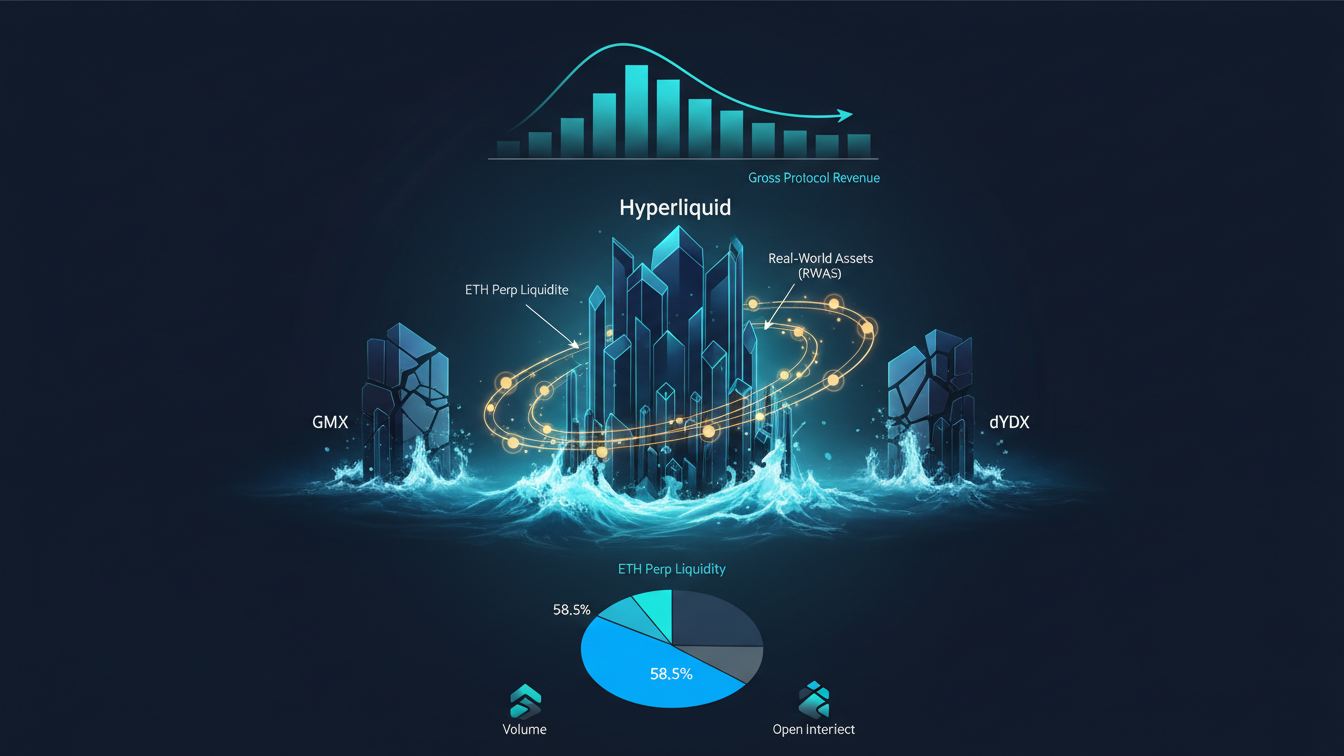
Hyperliquid captured 58.5 percent of perp DEX volume in August 2026, posting $2.9 billion in 24-hour trading and $7.1 billion in open interest while RWAs
Summary
- Hyperliquid captured 58.5 percent of perp DEX volume in August 2026, posting $2.9 billion in 24-hour trading and $7.1 billion in open interest while RWAs surpassed half of its activity.
- The platform generated $46.17 million in fees and $32.03 million in protocol revenue during the period, though gross revenue has declined from a $357 million peak in Q3 2025.
- GMX v2 and dYdX retain niches in oracle execution and order-book depth, yet Hyperliquid leads on fees and ETH perps liquidity depth.
Hyperliquid processed $2.9 billion in 24-hour perpetual futures volume with $7.1 billion in open interest as of August 2026. That single data point shows how far one decentralized exchange has pulled ahead in the defi derivatives race.
Hyperliquid has taken the top spot among perpetual futures DEXes with 58.5 percent market share. It now leads ETH perps liquidity while shifting more than half its trading activity into real-world-asset contracts. The shift marks a clear evolution for the platform and the broader perp DEX category.
Hyperliquid's Market Dominance
Hyperliquid has held the top spot in perp DEX volume for three consecutive months through August 2026. Its 58.5 percent share reflects sustained trader preference for deep liquidity and competitive fees on ETH perps and other major pairs. This concentration of flow has turned the platform into a de-facto benchmark for pricing and execution in decentralized derivatives.
The numbers illustrate the scale. Twenty-four-hour volume reached $2.9 billion while open interest stood at $7.1 billion. Those figures exceed the combined activity reported by many rival venues during the same window. Traders appear to reward the combination of low fees and reliable depth, especially on high-volume ETH perps contracts.
Protocol-level revenue tells a more mixed story. Hyperliquid collected $46.17 million in fees and retained $32.03 million as protocol revenue in the most recent period. While still substantial, the trend line shows contraction from earlier peaks. And honestly, that's a big deal for anyone betting on long-term token value.
Liquidity Metrics and Head-to-Head Comparison
Direct comparisons highlight where Hyperliquid pulls ahead. Against GMX v2 and dYdX, the platform records the highest 24-hour volume and open interest. It also posts the tightest fee structure for most trade sizes, giving it an edge on ETH perps execution.
- GMX v2 emphasizes zero-slippage oracle pricing, which suits certain large or directional trades.
- dYdX maintains an order-book model that appeals to professional traders seeking depth on select pairs.
- Hyperliquid combines competitive fees with broad liquidity across ETH perps and emerging RWA contracts.
The implication is straightforward. Volume and open interest have migrated toward the venue that minimizes cost and maximizes available size. GMX and dYdX continue to serve specialized use cases. Yet neither matches Hyperliquid's overall share in August 2026.
"Hyperliquid leads 24h perp volume at $2.9B with $7.1B open interest."
, Thrive.fi (Source)
Revenue Impact from RWA Expansion
RWA perps now account for more than half of Hyperliquid's trading activity. This expansion has brought new volume but also altered the revenue profile that supports the HYPE token. Gross protocol revenue peaked near $357 million in the third quarter of 2025 and has since declined each quarter, reaching roughly $295 million by mid-2026.
The shift occurs because RWA contracts often carry different fee structures and attract participants who trade less frequently or at lower margins than crypto-native perps traders. The result is higher notional volume alongside slower revenue growth.
This means that the same boom in real-world-asset derivatives that lifts total activity can simultaneously compress the revenue base that previously funded token incentives and ecosystem development. Which, if you've been watching this space, shouldn't be surprising. Observers will watch whether volume growth eventually offsets the per-trade margin compression.
"RWA perps are disrupting traditional DEX revenue models."
, Cryptonews.net (Source)
Synthesis
Taken together, the data show Hyperliquid consolidating its position in ETH perps liquidity while pivoting toward RWAs. The 58.5 percent market share and leading volume metrics confirm dominance on a flow basis. Yet the steady drop in quarterly protocol revenue introduces a clear tension between scale and monetization.
The weight of evidence suggests that leadership in defi derivatives now depends on managing both liquidity depth and sustainable fee capture. Hyperliquid has achieved the first. The second remains a work in progress.
What remains uncertain is whether the RWA-driven volume surge will stabilize or further erode per-trade revenue over the coming quarters. That question will shape how other perp DEX operators respond and whether Hyperliquid's current lead proves durable.