Mega IPOs from SK Hynix and SpaceX Drain Bitcoin Liquidity Amid Record Treasury Yields
SK Hynix raised $26.5 billion in its July 2026 Nasdaq debut after pricing ADRs at $149, coinciding with record 30-year Treasury yields at 5.058%.
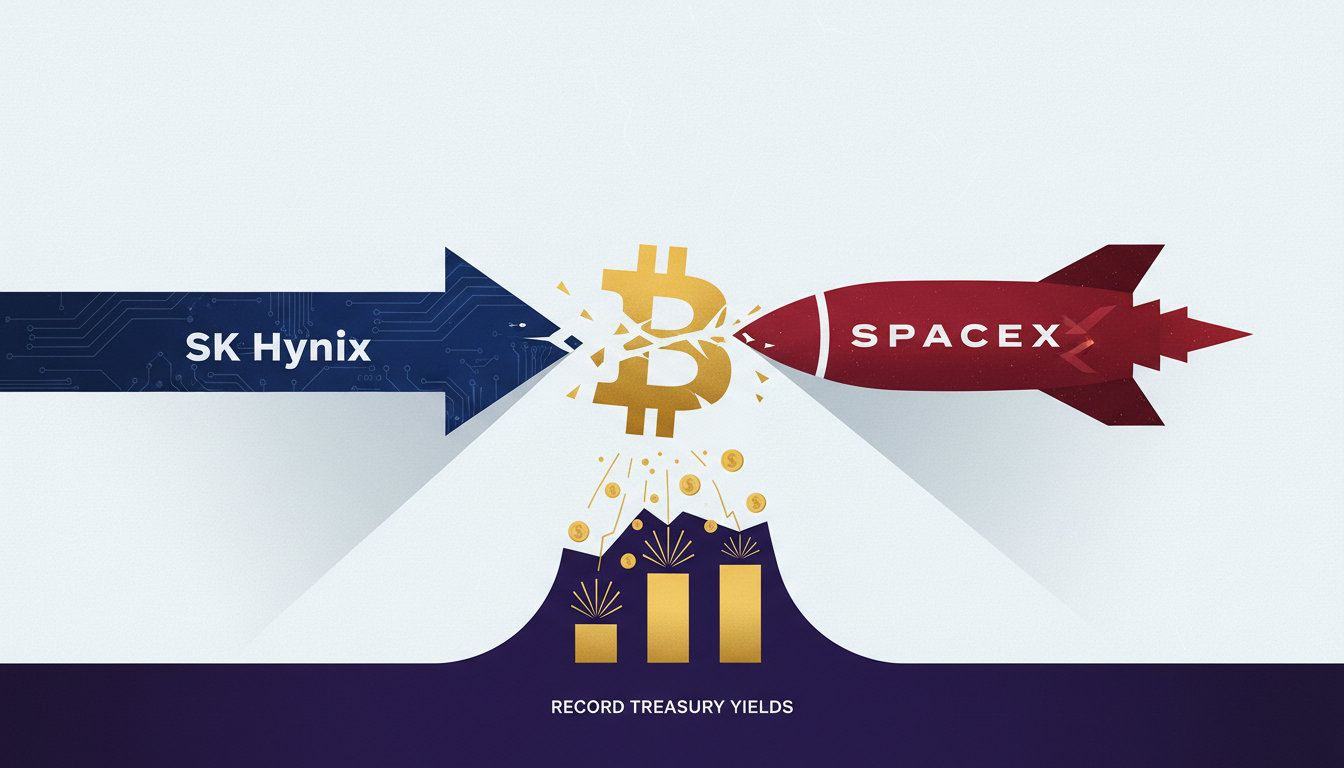
Summary
- SK Hynix raised $26.5 billion in its July 2026 Nasdaq debut after pricing ADRs at $149, coinciding with record 30-year Treasury yields at 5.058%.
- SpaceX plans a $75 billion raise in June 2026 as part of a potential $1.75 trillion IPO that blends aerospace, xAI, and crypto holdings.
- Bitcoin remained near $64,000 in USD terms even as gold fell toward $4,111, showing relative strength amid the equity market pull.
Markets hit a fever pitch in July 2026. SK Hynix pulled off the biggest foreign listing on Nasdaq yet, pricing its ADRs at $149 and raising $26.5 billion. The Treasury auctioned off $22 billion in 30-year bonds that same month, hitting a yield of 5.058 percent on July 9. That's the highest since 2007. SpaceX lined up its own $75 billion push amid all this.
The core thesis is straightforward. Record IPOs from SK Hynix and the planned SpaceX raises are signaling a high-valuation equity market that is pulling liquidity away from crypto assets including Bitcoin. The scale of these offerings, paired with elevated sovereign yields, creates a competitive environment for investor capital that favors traditional public markets over digital assets.
SK Hynix's Record Nasdaq Debut
SK Hynix priced its ADRs at $149 and closed the US offering at $26.5 billion according to Reuters reporting from July 2026. The transaction was more than seven times oversubscribed, reflecting strong institutional demand for exposure to advanced memory chips tied to AI infrastructure. The listing also narrowed the valuation gap with US peer Micron.
Micron itself dropped 18 percent in a single week despite posting record earnings. The decline occurred amid concerns that SK Hynix's large raise could pressure multiples across the sector, especially if institutions reallocate away from existing positions to participate in the new supply. Wall Street observers noted that the $26.5 billion raise may threaten NVIDIA-related multiples if capital continues to rotate into fresh semiconductor listings.
The implication is direct for liquidity pools. When an issuer of this size enters the public market, it absorbs cash that might otherwise flow into higher-risk segments such as crypto. AI-driven chip demand provided the fundamental backdrop, yet the timing of the raise amplified competition for deployable capital.
Treasury Yields and SpaceX Plans Add Pressure
On July 9 2026 the Treasury sold $22 billion of 30-year bonds at a yield of 5.058 percent. This level marked the highest auction result in nearly two decades and signaled that fixed-income investors could lock in attractive returns without venturing into equities or digital assets. Higher sovereign yields typically reduce the relative appeal of volatile growth assets.
SpaceX preparations compounded the effect. The company readied a $75 billion raise tied to a broader plan that could culminate in a $1.75 trillion IPO combining aerospace operations, xAI initiatives, and an existing $580 million Bitcoin treasury. The size of the planned raise again points to equity markets absorbing large tranches of institutional money at elevated valuations.
This means that both public debt and equity channels are actively competing for the same pool of funds. Crypto markets, which rely heavily on discretionary risk capital, face a narrower window for inflows when such sizable traditional offerings appear simultaneously.
"Bitcoin held near $64,000 while gold extended its slide to around $4,111. The US Treasury sold $22 billion of 30-year bonds at a high yield of ..."
, Attribution (CryptoRank)
Bitcoin Shows Relative Strength in USD Terms
Bitcoin traded near $64,000 during the period, demonstrating resilience in dollar terms despite the macro pressures. This level held even as gold prices declined, suggesting that some investors continued to view the asset as a store of value rather than purely a high-beta risk play. The contrast with broader liquidity drains is notable.
However, the picture is not uniform across currencies. Bitcoin lagged in JPY terms amid earlier Bank of Japan interventions that exceeded $73 billion in a single tranche. The divergence highlights that USD strength and domestic policy actions can mask underlying capital rotation away from crypto.
- SK Hynix ADR pricing at $149 captured substantial institutional allocation.
- 30-year Treasury yield reached 5.058 percent on July 9 2026.
- SpaceX planned raise of $75 billion adds to equity market absorption capacity.
- Bitcoin price stability near $64,000 occurred alongside gold weakness.
The data above illustrates how traditional channels absorbed capital without a corresponding collapse in Bitcoin's USD price, yet the absence of upside momentum points to constrained inflows.
Synthesis of Liquidity Dynamics
The weight of evidence suggests that large equity and debt offerings are competing directly with crypto for marginal capital. SK Hynix's successful raise and the Treasury auction results both occurred in July 2026, creating a narrow period when fresh supply met elevated yields. SpaceX's planned activity extends the same dynamic into later months.
This pattern does not imply immediate price collapse. It does indicate that any future Bitcoin upside will likely require either a moderation in traditional issuance or renewed risk appetite that overcomes the current yield advantage in sovereign bonds.
The implication is that crypto market participants should monitor the pace of large IPO filings and Treasury auction results closely. Sustained high valuations in equities paired with attractive fixed-income yields can extend the period of subdued inflows.
What remains to be seen is whether Bitcoin's current USD stability reflects genuine demand resilience or simply a temporary lag before broader liquidity effects become visible in price action. Which, if you've been watching this space, shouldn't be surprising.